
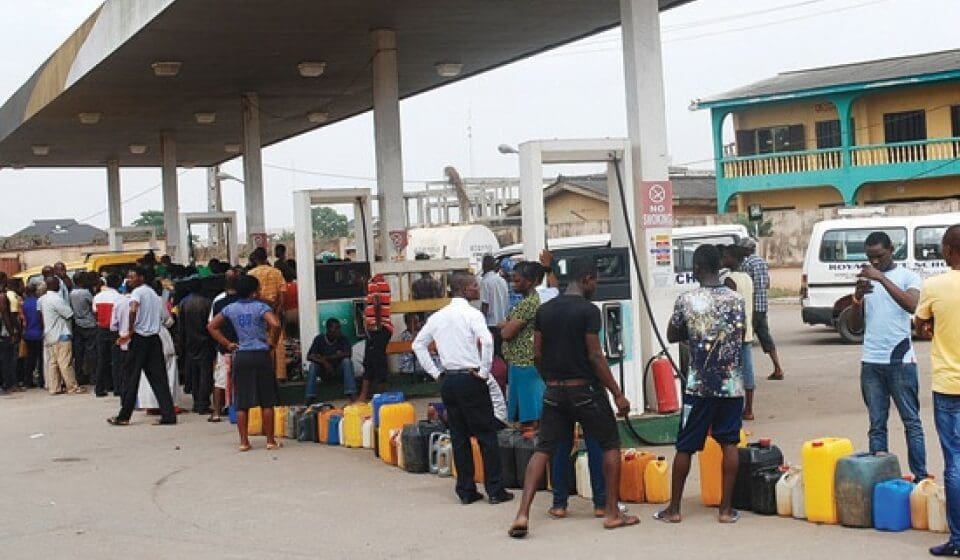

THERE is hardly any part of Nigeria where fuel is easily available now. The sad part of the fuel crisis is its implication for businesses, which are dying. The major reason for this blow on businesses is the ever-increasing price of diesel, the fuel on which major businesses run because the electricity distribution companies only struggle to supply epileptic power. Diesel is now N850/litre, and there are genuine fears it will eventually hit N1,000/litre. As crazy as this appears, it is the reality starring business owners in the face and the government seems not to have an answer to the challenge.
Amid the crisis, the debate over fuel subsidy removal has reared its head again. The Nigerian Extractive Industries Transparency Initiative (NEITI) earlier in week said the removal of Premium Motor Spirit (PMS) subsidy will free the economy from bondage. Its Executive Secretary, Dr. Orji Ogbonnaya Orji, said NEITI would release a researched Policy Advisory on the cost of fuel subsidy to Nigeria.
Orji said the publication “will outline facts and figures to reinforce NEITI’s position that reinforce our position that removal of fuel subsidy will free our economy from bondage, benefit the majority poor and possibly may hurt the few affluent rich currently involved in the subsidy transactions”.
But President Muhammadu Buhari said petrol subsidy removal was suspended because it was not in the country’s best interest. The President said while removing subsidy looks good on paper, the human consequences cannot be ignored. He maintained that it became inadvisable after assessing inputs from industry experts and other economic factors. “Most western countries are today implementing fuel subsidies. Why would we remove ours now? What is sauce for the goose is sauce for the gander.
“My government set in motion plans to remove the subsidy late last year. After further consultation with stakeholders, and as events unfolded this year, such a move became increasingly untenable.
“Boosting internal production for refined products shall also help. Capacity is due to step up markedly later this year and next, as private players and modular refineries (Dangote Refinery, BUA Group Refinery, Waltersmith Refinery) come on board. The exchange rate is still susceptible to external shocks that can suddenly and severely affect Nigerian citizens.
“As we step up domestic production – both in fuel (enabled by PIA) and food (agricultural policies) – the inflationary threat shall diminish, and we can move toward unification,” the President said in a written response to questions from Bloomberg.
The fuel challenge is so bad that the product is sold at different prices all over the country. For instance, in the Abia State capital, Umuahia, petrol is sold for between N170 and N220. In most filling stations in other parts of the state, it sells for between N170 and 175 per litre while in some parts of Zamfara State, it sells for as much as N220.
The scarcity of the product has given rise to hoarding, long queues and panic buying in service stations that are dispensing products. Some station owners refuse to dispense their products in anticipation of an increase in the pump price of PMS.
A World Bank report had predicted that production challenges in Nigeria’s oil sector would persist and affect growth. Titled Global Economic Prospects, the report projected the country’s growth to edge up to 3.4 percent in 2022, but will soften to 3.2 percent in 2023 and 2024.
Under the heading ‘Stagflation risk rises amid sharp slowdown in growth’, the report stated that “Production challenges in the oil sector are expected to persist, weighing on growth. A recovery in non-oil sectors is envisioned to continue, although shortages of fuel and higher food prices would restrain growth. Four in ten Nigerians live below the poverty line, with many more at risk of falling into poverty and becoming food insecure. Increases in food prices would further erode domestic demand.”
The fuel crisis would have had limited effect on businesses had power generation and distribution been well-handled. The country generates only 79,578.43MWh to serve its over 200 million population. The electricity supply to the distribution companies (DisCos) is only 78,529.1MWh.
Nigeria is still afflicted by lack of enough generation, transmission and distribution capacity to guarantee stable electricity supply, in spite of all the monies pumped into the sector since the return of democracy in 1999.
The country cannot continue this way. Something drastic must be done about the energy sector to ensure that both petroleum products and electricity become available across the land because energy is critical to productivity, growth and development.
Government must find a lasting solution to the perennial refinery crisis. It should fix the refineries and hand them over to competent and reliable private entities to run.
It is time power generation and distribution are completely decentralised and liberalised to accommodate more players who can generate and distribute with small and large-scale networks.
The successor electricity companies to the Power Holding Company of Nigeria must be made to perform in line with agreed terms and conditions under which they were considered.
Government must keep tabs on depot owners and service station operators to ensure they do not constitute themselves into overlords who operate to the detriment of the people and the economy of the nation. Something must be done to address this situation now before the Word Bank prediction becomes a reality.

