
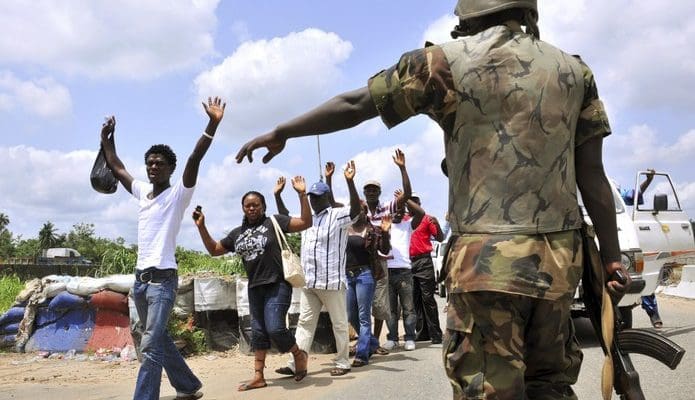

THERE is indeed a general concern about the state of insecurity in Nigeria today. The situation has gone beyond a national challenge to an endemic national problem. All the regions in the country are badly affected: Boko Haram insurgency and banditry in the North East; banditry and kidnapping in the North West, and communal clashes between herders and farmers in the North Central. There are cult-related crimes and kidnapping in the South West; separatist uprising and kidnapping in the South East, violent agitations and kidnapping in the South South and piracy on the country’s waterways. In fact, violent robbery and kidnapping are common to all the regions.
Several factors, mostly political, religious, social and economic, account for the astronomical progression of violent crimes and general insecurity across the country. For too long, the ruling class in Nigeria failed to adhere to the social contract of holding political power in trust for, and providing the basic needs of, the people. The state as an organic political entity failed to make education and public infrastructure readily accessible to the people. The failure of governance created a class of untrained and unemployable citizens who have now become a pool from where vested interests and undesirable elements find easy recruits for use in their nefarious activities.
This failure of governance predates the present administration. It is an age long fundamental malaise which dates back to the dawn of self-rule in 1960. However, the buck must stop somewhere, on someone’s desk. President Muhammadu Buhari must accept responsibility for the state of insecurity in the country and work harder to extricate Nigerians from this maze of social conflicts. Nigeria cannot afford another civil strife and its concomitant humanitarian crisis.
One of the reasons the President was voted into office in 2015 was because, as a former military head of state, it was assumed that he had all that it takes to confront the insecurity menace head-on. So, he must show leadership. Protection of lives and property of citizens is the primary aim of government. This should not be a subject for rhetoric, but must be self-evident. Nowhere is safe. Nigerians, including foreigners in the country, live in an atmosphere of apprehension. The level of killings across the country is alarming. Our cities, communities, highways and waterways are no longer safe.
Recent activities of Boko Haram insurgents, like the killing of 43 rice farmers in Borno State, leave much to be desired. The group was formed in Maiduguri in 2002 but started a rebellion in July 2009. In 2017, the federal government, through the Chief of Defence Staff, Gen. Abayomi Gabriel Olonisakin, disclosed that the Buhari government had spent $2.6 billion to address humanitarian crisis caused by the insurgent’s onslaughts in the North East region.
Olonisakin who was speaking at the meeting of the ‘Global Coalition Working to Defeat ISIS’ in Washington, D.C., USA was quoted to have said: “After over 2.6 billion dollars was spent by the Nigerian government to address humanitarian needs in 2016, more needs were seen when areas were recovered from Boko Haram”. If that was in 2017, it can only be imagined how much the country would have committed to humanitarian crisis alone, not to talk of weapons acquisition, logistics and troops maintenance.
A group, Network of Civil Society Organisations (NECSO), reported that no fewer than 23,000 Nigerians have been killed since the outbreak of the insurgency in the North-eastern part of Nigeria. Within the same period, a total of 2.15 million persons have been displaced from their homes and communities as a result of the crisis. The startling figures were disclosed at the Northeast Humanitarian Summit held as part of activities by the United Nations General Assembly to honour those killed by terrorists in Bagdad (Iraq), including a UN envoy, Sergio Vieira De Mello.
Similarly, officials of the Nigerian Union of Teachers (NUT) said that the insurgents killed over 600 teachers and displaced more than 19,000 others in some parts of the North. This was disclosed by Michael Olukoya, the national president of the union, who gave a breakdown of the casualties as follows: 308 in Borno, Adamawa (75), Yobe (18), Kaduna (25), Plateau (120), Kano (63) and Gombe (2).
These horrifying figures only go to confirm that the insurgents are the real enemies of the nation for which no amount of resources would be too much to spend to neutralise their threats. But arising from the Chief of Defence Staff’s disclosure are some worrisome questions on the fight against the terrorist group in the North East.
The federal government’s repeated claim that Boko Haram has been technically defeated has been severally called to question because each time that declaration is made, the group seems to be more audacious in its activities. Its seemingly invincible leader, Abubakar Shekau, whom soldiers claimed to have killed, has not only been speaking routinely but appears to have overcome the recent crisis that threatened his continued leadership of the group. The federal government eventually admitted that Shekau had not been killed. The immediate past Minister of Defence, General Mansur Dan-Ali, had explained then that it had been difficult to arrest Shekau because the insurgents usually wear masks to conceal their identity.
To address the very worrisome situation, activities of ‘crisis entrepreneurs’ must be checked. Stories of fraudulent handling of funds and relief materials meant for tackling the insurgency and violent crimes are commonplace — perpetrators must be fished out and dealt with if it must cease. Sponsors of conflicts and promoters of the country’s war economy make it impossible for Nigeria’s military to defeat the terrorists who are having a field day because of their selfish interests. They must also be identified and brought to book. Arms and food suppliers that keep the camps of the insurgents active must be identified and stopped. Government should adopt discreet intelligence to fish out all those whose activities feed the insurgents, and take appropriate action. The different security agencies involved in prosecuting the war must carry out their activities with a common sense of purpose. They should share credible and useful intelligence and fight as a team. The attendant issues of corruption, policy inconsistencies and lack of cohesion or proper co-ordination among the various security agencies must be tackled head-on. Also, Nigerians must see the war against insurgency and other violent crimes as a collective task, by helping the relevant agencies with useful information and by exposing those profiting from the crisis. It is high time a nationwide state of emergency is declared on insecurity.
Government must also double its efforts in tackling the issues that give impetus to violent crimes especially banditry, kidnapping, cultism and armed robbery. Most of the roads are in a terribly bad shape, and our public highways are lined with thick bushes which aid the activities of criminal elements and expose commuters to grave danger. Similarly, criminality thrives in dark spots. Proper lighting and regular supply of electricity could help to curb some of these criminal activities, especially in the cities and communities.
Government should leverage its “Big Brother” status in the West African sub-region and work with our neighbours like Niger, Mali, Chad, Burkina Faso and Cameroon with similar security challenges to fashion out a co-ordinated strategy that would see an end to the onslaught of terrorist elements and bandits, especially in the northern part of the country. It is an irony of fate that Nigeria which fought and brought peace to Liberia and Sierra Leone in the 1990s as leader of ECOMOG, the military arm of the Economic Community of West African States (ECOWAS), is finding it difficult to liberate itself from the claws of insurgents and violent criminals. Given the transnational nature of terrorism and banditry, it would not be out of place to call on government to seek external assistance, where necessary, to tackle the menace.
There is an urgent need for a renewed offensive against terrorism and other forms of criminality across the country. It is becoming obvious that the routine methods are incapable of sorting out the problem; and so we call on the federal government to set up a special task force to attack the menace with “deadly accuracy”. This task force should be given specific mandate and must be properly equipped to execute the task. It should be strictly monitored in order not to overstep its bounds. Nigeria did it in the 1980s when it quashed the Maitasine uprising. The country’s security agencies must also step up intelligence gathering to aid the activities of the taskforce and other combat formations.
To effectively overcome the security problem, there is need for a new security architecture as well as fast-tracking the roll-out of community policing to tackle the multi-faceted security problems. In all of these, government must work with traditional institutions and the civil society. The political class must see the current state of affairs as a national emergency and thus stop politicising national security issues. They should get together and face the common enemy irrespective of political affiliations. The survival of Nigeria should be uppermost in the collective consciousness of all Nigerians, and dealing a deadly blow to the insecurity nightmare is a mission that must be accomplished.


7 comments
… [Trackback]
[…] There you will find 55251 additional Information on that Topic: naijatimes.ng/insecurity-deal-with-the-problem-head-on/ […]
… [Trackback]
[…] Read More on that Topic: naijatimes.ng/insecurity-deal-with-the-problem-head-on/ […]
… [Trackback]
[…] Read More here on that Topic: naijatimes.ng/insecurity-deal-with-the-problem-head-on/ […]
… [Trackback]
[…] Read More on that Topic: naijatimes.ng/insecurity-deal-with-the-problem-head-on/ […]
… [Trackback]
[…] Info on that Topic: naijatimes.ng/insecurity-deal-with-the-problem-head-on/ […]
… [Trackback]
[…] There you can find 15761 additional Information on that Topic: naijatimes.ng/insecurity-deal-with-the-problem-head-on/ […]
… [Trackback]
[…] There you will find 71673 more Info on that Topic: naijatimes.ng/insecurity-deal-with-the-problem-head-on/ […]
Comments are closed.