

The revelations contained in a report by the Special Investigator on the Central Bank of Nigeria and Related Entities, reported last week in the media, have again thrown up the putrid stench of financial malfeasance in Nigeria’s public institutions and the level of impunity that exist in the handling of the country’s financial responsibilities.
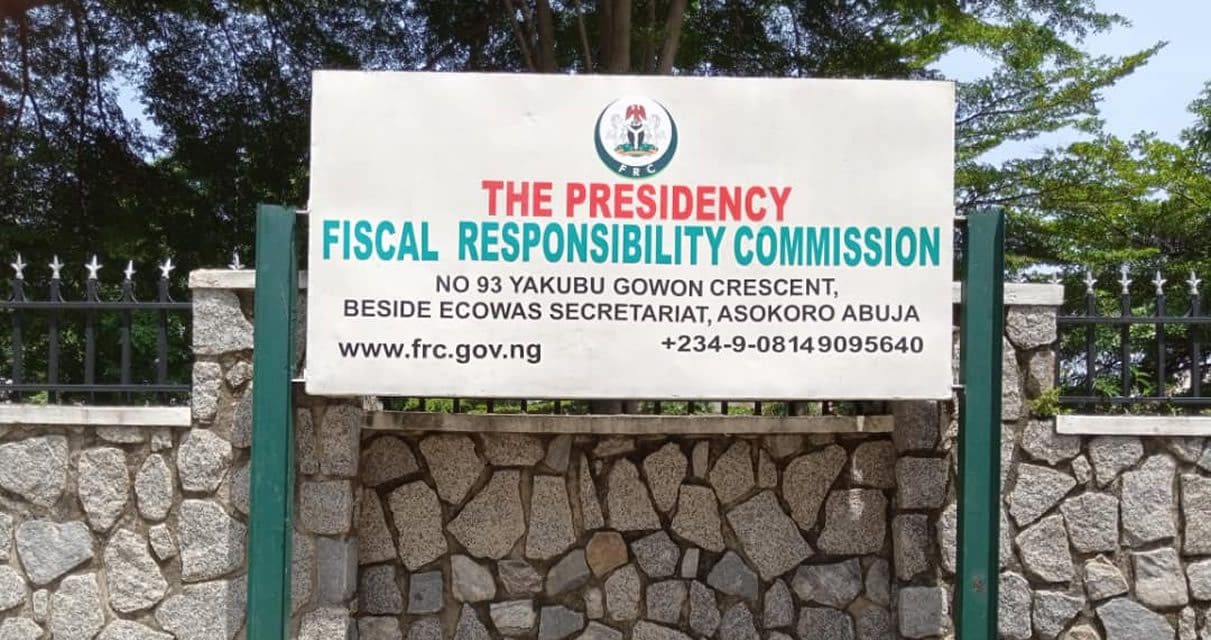
Although the contents are yet to be formally validated, they give an idea of what is going on in the country’s financial space and reveal the depth of absurdities perpetrated even in the most fundamental of institutions, those that hold the foundations of the country’s socio-economic survival. The most sordid indulgences are now found in the highest of places. Yet, the country has a Fiscal Responsibility Act (FRA), which came into force on July 30, 2007, and a Fiscal Responsibility Commission (FRC) which has a responsibility to drive its provisions.
The FRA (2007) is an Act of the National Assembly promulgated to provide for the prudent management of Nigeria’s resources, ensure long-term macro-economic stability of the national economy and secure greater accountability and transparency in fiscal operations within a medium-term fiscal policy framework. It empowered the establishment of the FRC to ensure the promotion and enforcement of the nation’s economic objectives as well as other related matters.
The Commission has a responsibility of ensuring the transparent and accountable government financial management framework for the country as well as ensuring that revenue-raising policies and resource allocation and debt management decisions are undertaken in a prudent, transparent and timely fashion.
The Commission is further empowered by law to compel any person or government institution to disclose information relating to public revenues and expenditures and cause an investigation into suspected or reported violations of any of the provisions of the Act. The report of such investigations must be sent to the Attorney-General of the Federation for possible prosecution. The objective was to help promote economic desires contained in section 16 of the Nigerian Constitution. Implementation of all these seems not to be obvious, going by current realities.
During the ongoing budget defence and 2024 budget presentation at the National Assembly, the Senate passed a resolution to amend the FRA to further empower the Commission in the discharge of its duties, apparently based on matters arising from the Medium Term Expenditure Framework (MTEF) report. The Senate claimed the move was to strengthen fiscal policies and address concerns related to Nigeria’s growing debt burden as it emphasised the crucial role of the FRC in monitoring fiscal policies and aligning them with monetary policies. Yes, the FRC has a crucial role, but how well has it played that role?
From time, Nigeria’s challenge has never really been policy inadequacy but the diligent implementation of existing regulatory and operational provisions. Oftentimes, holes are punched in policies and plans by critics but evidence abounds that even the best promulgations get crippled and buried at the implementation stage. A globally acclaimed policy like the Economic Recovery and Growth Plan (ERGP) 2017-2020, was crippled, killed and buried at the implementation stage and the successor Medium Term National Development Plan (MTNDP) 2021-2025 is yet to gather traction.
Going by the available provisions of the FRA 2007, it can be presumed that the lack of resolve more than inadequate authority to deal with the issues involved is responsible for the inability of the Commission to live up to its billing. It is why corruption and mindless plundering of the nation’s resources have become commonplace. Long-term macro-economic stability of the national economy and securing greater accountability and transparency in fiscal operations now look like a mirage. Enforcement of the nation’s economic objectives has become like a fantasy.
For reasons that cannot be hanged on lack of authority, it is not so obvious that the Commission has fundamentally caused an investigation into suspected or reported violations of the provisions of the Act; neither can it be said that it has dutifully reported, forwarded or followed-up fundamental investigations for possible prosecution. The level of fiscal infractions perpetrated in public institutions is mindboggling. It is more of attitude and mindset than the law.
Going by the series of unbecoming revelations in the country’s financial space, there is no doubt that institutions saddled with the responsibility of dealing with these anomalies should be better empowered, but institutions given oversight responsibilities must also ensure that they exercise such roles to accomplish the aim for which those institutions were established.
The National Assembly itself is a culprit when it comes to financial responsibility. Its budget is shrouded in secrecy and seems unaccountable to anyone. Also, if the various committees of the legislature had been alive to their vetting and oversight responsibilities, some of these infractions would have been averted and perpetrators would have been deterred. The Auditors are not helping matters as these anomalies are often not spotted until independent investigators are brought into the picture. The criminal justice system seems to be rewarding big-time scoundrels. Those prosecuted at all either get some reprieve or just a mild slap on the wrist.
Instead of always moving to amend the law, the National Assembly should first seek the underlying challenges so that it does not end up curing symtoms instead of ailments. It should strengthen its own internal mechanisms to ensure that already existing rules and regulations are implemented and obeyed. Other regulatory and supervisory entities within the system must not just do, but be seen to be doing, their jobs. There must be consequences for bad behaviour otherwise it becomes a trend and eventually the norm.
Government must strengthen the structures that deal with fiscal responsibility and accountability and enforce punitive actions where there are infractions. Often, amendments to laws in this country are not meant to cure implementation disabilities but to give more coercive and protective powers to those in charge of the execution of tasks. This must stop if this country is to make meaningful progress.
We are not averse to amendment of laws where necessary, we are saying laws must not be amended just for the sake of it, or because some persons have complained against the provisions. More diligent interrogation is required because action is taken. The amendments must be in the public interest and should help in the diligent execution of tasks.

