
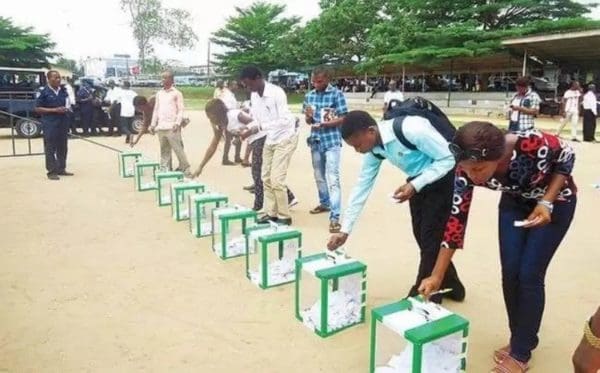

SATURDAY, November 6, 2021 has been slated by the Independent National Electoral Commission (INEC) for the conduct of the Anambra State governorship election. The state is one of those whose governorship election holds out of the normal general election calendar. A few other states including Edo, Ondo, Osun and Ekiti also fall within this category.
This would not be the first time governorship election would be holding in the state in this format, but the one scheduled for next Saturday has raised more dust which has thrown up a lot of concerns in different quarters. The most potent of the concerns is the posturing by stakeholders which has raised the question of whether or not the election will hold. Clearly, there would be implications if the election is disrupted by contentious groups.
The South East geo-political region has been engulfed in violent crisis for some time now following the demand by some groups for inclusion and political autonomy. The demands follow claims of isolation, oppression and marginalisation in the scheme of things in the country. Agitations which followed successively assumed another dimension with the eventual emergence of the Indigenous People of Biafra (IPOB), which introduced a more physical dimension to the struggle bordering on direct violent confrontation with the central government.
Although the organisation has severally denied calling for boycott of elections holding in any of the South East states, there have been claims that it has vowed to disrupt the Anambra governorship election unless their detained leader, Nnamdi Kanu, is unconditionally released from detention. Those pushing the claim point to the six days’ sit-at-home order by the group which runs through the period the election has been scheduled to hold.
Other non-descript groups are also said to have threatened to disrupt the election; and a number of violent incidents in the last three months have signposted a possible threat to the election. The various threats have fuelled some fears leading to quite a number of other narratives including the insinuation that all the ad hoc staff employed by the electoral body for the exercise have resigned, fearing for their safety. INEC has since debunked the claim, even if there are still some unanswered questions.
Assuming the threats are carried out, how would the electoral body convey its personnel and materials to the polling units? Has it made enough logistics arrangement to beat any unforeseen circumstances? Given the antecedents, particularly in Anambra State, what happens in a situation where the people, largely out of fear for their safety, decide to stay at home and not take part in the exercise? With all the threat signals, election monitors, particularly foreign observers, may be apprehensive of being part of the election. What would be the effect of that on the credibility of the exercise in the eyes of the international community?
Some commentators have claimed that IPOB never gave any specific order for the disruption of the election; that it is merely a perception of an incidental order that followed the postponement of the trial of Kanu (to November 10, 2021). The IPOB leader was in court on October 21. The group wants his unconditional release by November 5; which is why they ordered a six day sit-at-home beginning November 4, 2021.
A number of reactions have followed the alleged attempt to disrupt the election. The Federal Government says the election must hold, no matter what; and President Muhammadu Buhari has given marching orders to security agencies to ensure that the exercise holds and conducted in a free and fair manner. Heads of the various security agencies, including the National Security Adviser, have vowed that the election must hold. They have already commenced deployments.
The umbrella socio-cultural organisation of the Igbo, Ohaneze Nd’Igbo, has also voiced out its concern. It says although the people have enough and genuine reasons to be aggrieved, disrupting or boycotting the election would not be in their interest. In fact, it warned of the implications of doing so; a development which could be counterproductive given the current scenario and realities on the ground. Some concerned Igbo leaders have expressed similar sentiments, stressing that it would be more in the interest of the people to go ahead with the election than risk more crisis that would follow a disruption.
We believe that the Ohaneze organisation is right. The primary question to pose is: why do we have elections? Would Ndigbo allow an individual or an issue stand between them and an election, knowing that the consequences may be greater than the whole idea of not having it? Agreed that it is legitimate for a people to use critical moments to push their case, but looking beyond such demands, what would be the implications of an election being cancelled on account of a sit at home order? If that becomes a standard practice, who loses in the end? Although there are issues to be sorted out, are those issues going to be sorted out by cancelling or boycotting an election?
It is obvious that the issues will still linger. The Federal Government will only take note and the crisis will continue. It is neither in the interest of the people of the state nor democracy to start canvassing that an election be suspended because of issues that would continue to linger anyway.
Those who believe the election should not or cannot hold should look at the bigger consequences. This is an election that would produce the next governor of the state. Will there be a vacuum if the election fails to produce a successor at the expiration of the tenure of the incumbent? Obviously no! The simple reason is that the constitution does not make any such provision. The Federal Government would be left with no option than to declare a state of emergency and bring in an interim government. The constitution gives government that power. It has happened in some other states before. This would have a snowball effect that would lead to a multiplication of crisis. It would become a self-inflicted injury. The question again arises: will the possible outcome be better than the situation on ground? Things are likely to be made more complex.
Already the state government has suggested shifting school days from the current Monday to Friday format to a Tuesday to Saturday format because of the sit-at-home regime imposed across the region on Mondays by IPOB. The affected areas are already suffering the negative consequences of this development; any additional sit-at-home order might be disastrous. We do not think adjusting the school calendar is a reasonable proposal, apparently because of the negative signal it would emit. If another group emerges with its own demand, would the state government also make similar adjustments? For how long will it continue?
Without playing down on the reasons that necessitate the seemingly irregular demands, including the sit-at-home order, it would not make much sense to try to stop or disrupt the election. This is not a case of the end justifying the means, because the end might turn out to be more catastrophic than what is happening now. It is obvious that the Federal Government will not succumb to any group of people when it comes to cancelling an election. So, it would amount to a case of cutting one’s nose to spite his face, if the people insist.
It could therefore be assumed that IPOB is just seeking relevance and trying to use the Anambra election as a means to an end – a veritable avenue to be in the spotlight. But it must also be noted that no responsible government will allow non-state actors to create confusion in such a critical national democratic exercise.
The electoral body says it is ready to conduct the governorship election. It has already moved in non-sensitive materials and deployed relevant personnel. Apart from the recently converted 86 polling units, which for now have no registered voters, the body says it is poised to cover all the electoral zones in the state. Security agencies are already conducting some preparatory exercises. The National Assembly has given INEC the go-ahead to use the electronic voting and result transfer process.
We believe that the current situation in the country must not continue. Government must find a way, and very soon, to resolve all lingering matters that give vent to discontents and agitations, not only in the South East region but wherever else it is noticeable. While ensuring that non-state actors do not dictate the pace of activities in the country, government must, as a matter of necessity, enter into discussion with genuine groups with reasonable demands within the contending zones.
It is in the wider interest of the country that this is done speedily. Although it is our position that the Anambra State election must be allowed to hold without let or hindrance, the concerns of contending bodies, some of which are reasonable, must not be swept under the carpet. Government has to revisit the issues being raised and canvassed by those who feel not properly carried along in the polity. Confrontations never really solve problems; all parties must therefore think in the direction of finding workable political solutions to the contentious problems.

