

ON JANUARY 26, 2021, President Muhammadu Buhari succumbed to public pressure to replace his four service chiefs who had each spent about 66 months in office. The President accepted their resignation and immediate retirement from military service.
The former service chiefs were: Chief of Defence Staff (CDS), General Abayomi Olonisakin; Chief of Army Staff, Lt-General Tukur Buratai; Chief of Naval Staff, Vice Admiral Ibok Ekwe Ibas and Chief of Air Staff, Air Marshal Sadique Abubakar. The President thanked them for what he described as their “overwhelming achievements in our efforts at bringing enduring peace to our dear country.” He wished them well in their future endeavours.
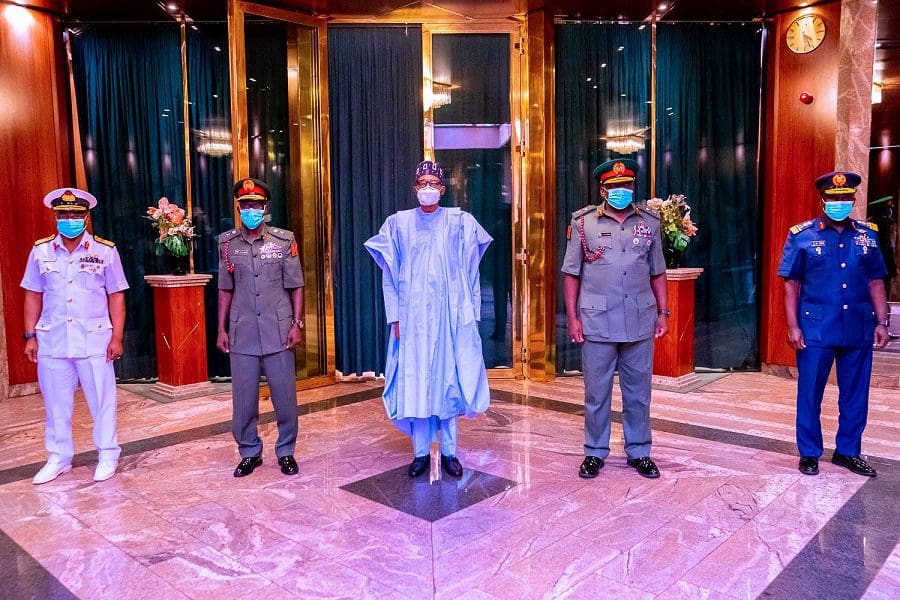
The new helmsmen are: Major-General Leo Irabor, Chief of Defence Staff; Major-General Ibrahim Attahiru, Chief of Army Staff; Rear Admiral Awwal Gambo, Chief of Naval Staff and Air-Vice Marshal Ishiaka Amao, Chief of Air Staff.
In furtherance of Section 18 (1) of the Armed Forces Act Cap A.20 Laws of the Federation of Nigeria, the President has communicated the appointment of the Service Chiefs to the National Assembly and has sought for the confirmation of the said appointment by the Senate through his letter to the Senate President dated January 27, 2021.
President Buhari met with and congratulated the newly appointed Service Chiefs on the day of their appointment. His spokesman, Femi Adesina, in a statement, quoted him as saying: “We’re literally in a state of emergency. Be patriotic; serve the country well, as your loyalty is to the country… There’s nothing I can tell you about the service, because you are in it. I was also in it, and I will pray for you. I also assure you that whatever I can do as Commander-in-Chief will be done, so that the people will appreciate your efforts… You know the stage we were in 2015, you know the stage we are now, and the undertakings we made. We promised to secure the country, revive the economy, and fight corruption. None has been easy, but we have certainly made progress.”
Among other strategic issues, the President wants the new helmsmen to focus on the morale of their officers. They must be made to feel physically and professionally secure. The new CDS has pledged the commitment of his colleagues to ensuring safety and security of lives and property across the country. Considering their field experience and knowledge of the environment, he acknowledged that expectations from Nigerians are high; and they are mindful of it. “So, we collectively will work to achieve that”, he promised.
The continued degeneration of the national security situation had led to strident and repeated demands by Nigerians across board for the replacement of the service chiefs, but the President kept them until last week. Their eventual sack was not as a result of incompetence, the Presidency has said; but to inject fresh blood, new ideas and fresh energy. Although a number of stakeholders see the replacements as coming rather late, it is still better late than never.
Critics have called for the investigation of the replaced helmsmen whom they believe did not perform to expectation, given the observed security lapses and alleged corrupt practices and the “war economy” that was created under their watch. They point to the resurgence of ethnic vigilante and regional security outfits as evidence of lack of confidence in government security apparatus during their tenure.
The new service chiefs therefore have enough challenges on their plates as expectations are sky high. They must therefore take urgent and proactive steps to equip their troops, restore professionalism, boost their morale with necessary incentives, review strategies and tactics and avoid the pitfalls that hamstrung their predecessors. They must demonstrate, through successful onslaught against insurgents and restoration of peace in troubled areas, to justify the confidence reposed in them by the Commander-in-Chief.
Since the announcement of the appointments, individuals and groups across the country have made various demands on the appointees and also indicated expectations. Ordinarily, their duties are well cut out. Having been part of the team that have been fighting insurgency and other forms of insurrections across the country, the new chiefs are assumed to already know the terrain and understand the demands of their new positions, and are therefore expected to hit the ground running.
Their urgent mandate includes halting the descent into anarchy arising from the alarming state of insecurity in the country. They are also expected to return the country to a state where citizens can again be free to go about their normal endeavours in peace and safety. Nigerians want a complete crackdown on widespread banditry, kidnapping, sectarian violence; armed robbery and a general break down of law and order.
While joining in this call, we are nonetheless mindful of the fact that the new service chiefs are not magicians and therefore not going to perform magic. That notwithstanding, they have a responsibility to defend their classification in the best professional manner possible. There are about 27 formations in the country dealing with security issues, so changing the heads in four of the formations, even if strategic, is not going to fundamentally change things overnight.
It must be noted however that addressing the security challenges of the country goes beyond the replacement of four service chiefs. It would be too simplistic to even contemplate that. It requires deeper inquest into the fundamental enablers of the situation and collaboration among security agencies and relevant stakeholders at all levels across the country and the region.
It is therefore necessary that other security formations close ranks with the new military chiefs in a coordinated approach to tackle the hydra-headed security challenges confronting us. This call is in view of past experiences where sharing of intelligence and strategic logistics information became problematic, a development which stalled effective coordination that would have helped in dealing with the precarious security situation facing the country.
For the avoidance of doubt, the military’s primary responsibility is the defence of the country’s territorial integrity. The military deals largely with external aggression but the situation in the country over the years which has overwhelmed the internal security organs, has necessitated the drafting of the military into tackling internal security challenges.
It is time the other security agencies whose primary responsibility is to deal with internal security issues like armed robbery, kidnapping, cultism, assassinations, communal crisis, etc., live up to expectation and free the military to frontally face external challenges fostered by insurgency, piracy, cross-border criminalities, international conspiracies, etc. Every necessary step must be taken to enable the service chiefs discharge their responsibilities.
Since it has been established that the increasing wave of banditry, kidnapping and violent robbery are as a result of incursions through the country’s porous borders, the Federal Government must explore all necessary avenues to intensify border patrols and collaboration with authorities in neighbouring countries to check the influx of criminal elements across the respective borders. It should also investigate why our borders have remained porous in spite of the presence of security agents at the major posts.
Nigeria urgently needs a Sustainable National Security Stabilisation Action Plan (SUNSSAP) that outlines a holistic reform and modernisation of the country’s security operations, to bring it up to speed with global best practices in security management. The plan should spell out a national, regional and continental collaborative framework of action that will comprehensively and decisively address security challenges at all levels. This should involve all the heads of strategic military and intelligence services, the ministries and agencies performing oversight responsibilities, the National Security Adviser (NSA), as well as relevant and knowledgeable stakeholders outside key military and intelligence formations across the country. Security agencies must come to terms with modern trends in tracking and combating crime as well as fighting insurgency and insurrections through effective deployment of intelligence and technology.
Effective engagements and collaboration with neighbouring countries have become more relevant now than ever before, to check cross border criminality and insurgency. Regional, continental and global bodies must collaborate to stem insecurity across the globe if peace and economic growth is to be attained, especially in afflicted countries. Protocols that seem to give impetus to unrestricted movement of persons across international boundaries should be urgently reviewed to promote peace and development of member countries.
At the regional level, there is also an urgent need for the ECOWAS Commission to hold strategy meetings of the regional military chiefs, national security advisers, police chiefs, and Heads of State and Governments to address the security challenges of the region. It would not be out of place to raise a regional peacekeeping mission in the mould of ECOMOG to deal with the challenges in the Sahel and Savannah regions. The issue of proliferation of small arms should be an area of intense focus for the region to enjoy relative peace.
Apart from the service chiefs being fully involved in all the initiatives aimed at bringing stability to troubled zones in the country and the region, there is a need for a comprehensive assessment of military equipment requirements, human capacity optimisation and relevant institutional reforms, so as to fill all gaps in the renewed efforts against insecurity.
More than any other time in Nigeria’s history, the heightened insecurity nationwide demands that the service chiefs discharge their assignments with a high sense of responsibility, determination and commitment to secure Nigeria and restore peace, order, good governance and national cohesiveness in our dear nation. Nigerians have heard enough excuses for failure to stem the tide of insecurity; they are not likely to welcome more. The service chiefs have their jobs well cut out for them by the Commander-in-Chief and they should hit the ground running with clear key performance indicators and results in focus.
The three tiers and arms of Government must actively demonstrate sufficient will and political commitment, capacity and coordination to support the service chiefs to have a successful tour of duty during their tenure. Nothing less will suffice to keep Nigeria as one country for the present and future generations.


3 comments
… [Trackback]
[…] Find More on to that Topic: naijatimes.ng/agenda-for-the-new-service-chiefs-to-combat-insecurity/ […]
… [Trackback]
[…] Read More here to that Topic: naijatimes.ng/agenda-for-the-new-service-chiefs-to-combat-insecurity/ […]
… [Trackback]
[…] Read More to that Topic: naijatimes.ng/agenda-for-the-new-service-chiefs-to-combat-insecurity/ […]
Comments are closed.